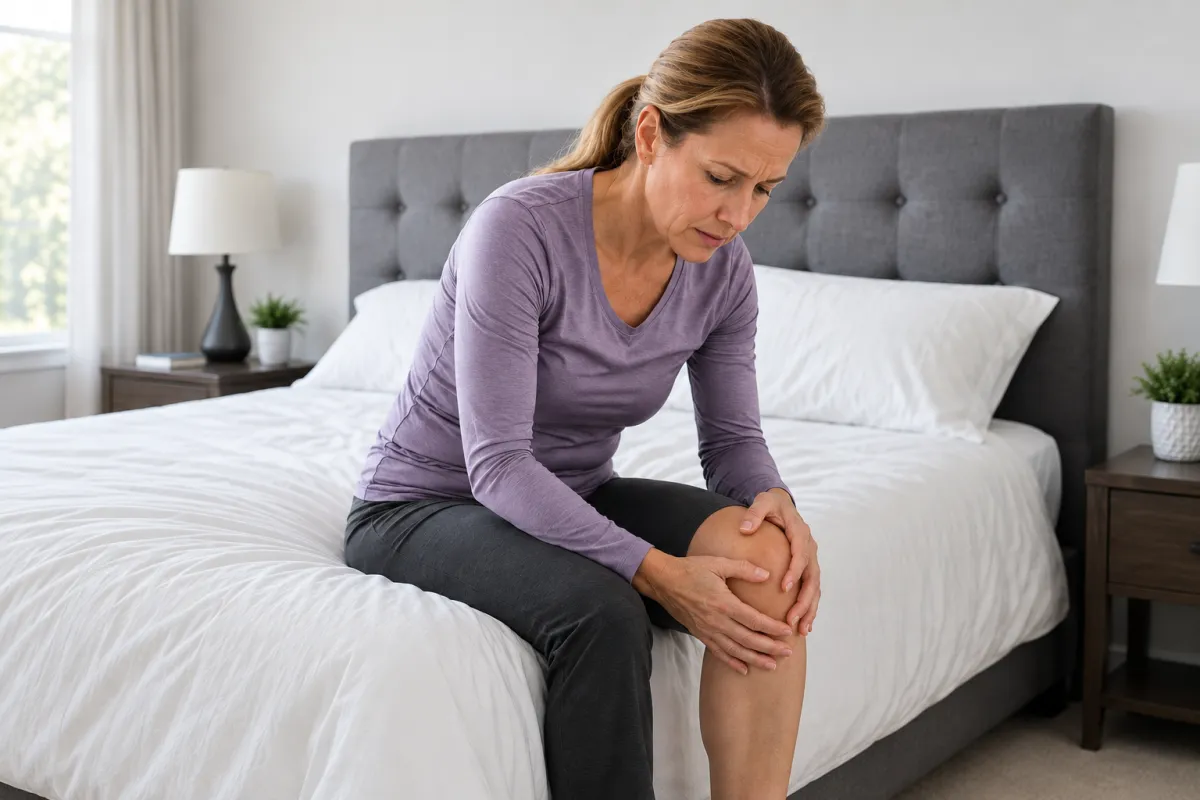
The MidLife Joint Pain Nobody Warns You About
You wake up with stiff knees. Your back aches for no obvious reason. Even getting up after sitting too long suddenly feels different after 40. You didn't injure yourself, so where did all these new aches and pains come from?
Maybe it starts when you get out of bed.
Your feet hit the floor, you stand up, and your knees need a few seconds to cooperate.
Or you get out of the car after a long drive and suddenly feel stiff.
Then your hip starts aching.
Or your shoulder.
Or your hands.
Nothing dramatic happened. You didn't fall. You didn't injure yourself. You didn't suddenly start training for a marathon.
Yet somewhere in your 40s or 50s, your body seems to have acquired a collection of aches and stiffness you don't remember signing up for.
So naturally, you assume you're getting older.
But what if age isn't the whole story?
Because for women in midlife, there may be another change happening at exactly the same time.
And surprisingly few of us are warned about it.
The Menopause Symptom We Don't Talk About Enough
Hot flashes?
Everyone has heard about those.
Night sweats? Expected.
Irregular periods? No surprise.
But aching joints, morning stiffness and the strange feeling that your body has suddenly become less forgiving?
That catches a lot of women completely off guard.
And it may be much more common than you realize.
A 2026 systematic review and meta-analysis looked at 37 studies involving more than 93,000 women across 22 countries.
Researchers found muscle or joint pain in about:
40% of premenopausal women.
57% of perimenopausal women.
59% of postmenopausal women.
In other words, more than half of the women in the perimenopausal and postmenopausal groups reported muscle or joint pain.
That's a pretty startling number for something many women enter midlife knowing almost nothing about.
But there's an important catch.
It doesn't mean every aching knee after 40 is caused by menopause.
And that's where this story gets much more interesting.
Your Joints Didn't Suddenly Get the Memo That You Turned 40
One of the strangest things about midlife aches is how abruptly they can seem to appear.
One day, stairs are just stairs.
Then suddenly your knees have an opinion about them.
You sit through a movie and feel stiff when you stand.
You sleep on one side and your hip complains.
You wake up after eight hours in bed and somehow feel as though your body has been sitting in storage overnight.
It can feel as if something changed almost overnight.
But the processes behind pain and stiffness are more complicated than that.
Age matters. Previous injuries matter. Muscle strength matters. Activity matters. Sleep can matter. Body weight can matter. Osteoarthritis and other medical conditions can matter.
And increasingly, researchers are asking another question:
What role do the hormonal changes of menopause play?
Estrogen Does More Than You May Think
Most of us learned about estrogen in the context of periods, fertility and reproduction.
But estrogen has effects throughout the body, and researchers have increasingly examined what happens to the musculoskeletal system as hormone levels fluctuate and decline during the menopause transition.
A major review in The Lancet Rheumatology concluded that changes in or loss of sex hormones appear to influence susceptibility to musculoskeletal pain and potentially painful osteoarthritis. But exactly how those relationships work, and whether hormone treatment can reliably prevent or treat these problems, is much less settled.
That's an important distinction.
It's tempting to turn the science into a neat little equation:
Less estrogen = painful joints.
But human bodies rarely cooperate with neat little equations.
The association between menopause and musculoskeletal pain is increasingly compelling.
The explanation is still being worked out.
There's Even a New Name Being Discussed for It
Here's where things get particularly interesting.
In 2024, researchers proposed a term you may never have heard before:
“The musculoskeletal syndrome of menopause.”
They used it to describe a collection of musculoskeletal changes associated with the menopause transition, including joint pain, loss of muscle mass, loss of bone density and progression of osteoarthritis, among other changes.
That doesn't mean this is now a universally accepted diagnosis that explains every ache a woman experiences after 40.
It isn't.
But the fact that researchers are proposing terminology for this collection of symptoms tells you something:
Midlife musculoskeletal changes are getting considerably more attention than they used to.
And perhaps they should.
Because joints aren't the only part of the story.
Sometimes “Joint Pain” Isn't Just About the Joint
When your knee hurts, it's natural to think:
Something is wrong with my knee.
But movement depends on an entire system.
Muscles help stabilize joints.
Tendons connect muscle to bone.
Ligaments help stabilize joints.
Bones, cartilage and other tissues all contribute to how comfortably and confidently you move.
And muscle becomes especially important as we age.
That's one reason a conversation about midlife mobility can't stop at:
“How do I make this joint stop hurting?”
A better question may sometimes be:
“What is happening to the entire system that supports the way I move?”
Because preserving mobility isn't simply about avoiding pain.
It's about preserving strength and function.
Getting out of a chair without thinking about it.
Climbing stairs.
Carrying groceries.
Walking for an hour.
Getting down onto the floor and getting back up.
Doing the things you've always done without calculating whether your knees or hips will cooperate first.
Those ordinary movements are easy to take for granted.
Until they aren't.
Then There's the 7 A.M. Clue
Here's something worth paying attention to:
How do you feel when you first get out of bed?
Morning stiffness can be a feature of osteoarthritis. The National Institute on Aging lists stiffness after getting out of bed among common osteoarthritis symptoms, along with pain, swelling and tenderness. Osteoarthritis commonly affects the hands, knees, hips, feet, neck and lower back.
But morning stiffness by itself doesn't tell you exactly what's causing it.
The pattern matters.
Which joints hurt?
How long does the stiffness last?
Does movement make it better?
Does movement make it worse?
Is there swelling?
Is the pain on one side or both?
Has it been getting progressively worse?
Those details can tell a healthcare professional much more than simply:
“Everything hurts lately.”
And there's another clue you may not immediately connect to your joints.
That Terrible Night's Sleep May Matter Too
Remember waking up at 3 a.m.?
Sleep and pain aren't necessarily two completely separate midlife problems.
Research on menopause-associated pain has identified sleep disturbance among the factors that can modify pain perception and its effect on daily functioning.
Think about what that can look like in real life.
Your hip aches, so you keep changing positions.
You don't sleep well.
The next day you're exhausted, less active and pain feels harder to tolerate.
Then discomfort makes the following night's sleep difficult again.
Pain disrupts sleep.
Poor sleep can make pain harder to deal with.
And around you go.
That's why looking at midlife symptoms one at a time can sometimes miss the bigger picture.
Your body doesn't know that “sleep” belongs in one blog category and “joint health” belongs in another.
These systems interact.
The Instinct to Move Less Can Backfire
Here's the cruel part.
When something hurts, what do most of us instinctively want to do?
Stop using it.
Your knee hurts, so you walk less.
Your hip aches, so you avoid exercise.
You feel stiff, so sitting still seems safer than moving.
For an acute injury or certain medical conditions, activity may absolutely need to be restricted or modified.
But for osteoarthritis, appropriate physical activity is actually an important part of management.
The National Institute on Aging notes that a safe, well-rounded exercise program can help reduce joint pain and stiffness while improving flexibility, muscle strength and endurance. Regular physical activity among older adults with arthritis is also associated with better physical function and quality of life.
It doesn't mean:
“Push through severe pain.”
It doesn't mean:
“Ignore an injury.”
And it certainly doesn't mean every exercise is right for every body.
It means the answer to aching joints isn't automatically to stop moving altogether.
Sometimes the body you are trying to protect from movement actually needs the right kind of movement.
Strength May Be One of the Most Underrated Parts of Healthy Aging
We tend to talk about exercise as something we do to burn calories.
After 40, there is a much bigger reason to care about it.
Function.
Strong muscles help us perform the ordinary movements that make independence possible.
Standing up.
Climbing.
Lifting.
Carrying.
Balancing.
Walking.
And continuing to do those things decades from now.
That's why resistance exercise becomes so interesting in a conversation about healthy aging.
The goal doesn't have to be bigger muscles.
It doesn't have to be a certain number on a scale.
It doesn't have to be looking twenty years younger.
The goal can simply be to keep doing what you love for as long as possible.
That's a very different reason to get stronger.
But Please Don't Blame Every New Ache on Menopause
This may be the most important section of this article.
Once women discover that musculoskeletal pain is common around menopause, it's easy to swing too far in the opposite direction.
Your knee hurts?
Hormones.
Your hands are stiff?
Hormones.
Your hip aches?
Must be menopause.
Not necessarily.
Osteoarthritis becomes more common with age, and women are particularly affected after age 50. Previous joint injuries, repetitive joint stress, family history and excess body weight can also increase osteoarthritis risk.
Other musculoskeletal, inflammatory and autoimmune conditions can cause joint pain as well.
And despite the growing interest in estrogen and musculoskeletal symptoms, researchers themselves continue to caution against turning an association into a simple cause-and-effect explanation.
Even hormone therapy isn't a simple answer to midlife musculoskeletal pain. A 2026 systematic review and meta-analysis found no significant pooled effect of ever versus never using hormone replacement therapy on generalized musculoskeletal pain, while results for specific conditions were too heterogeneous or conflicting to draw firm conclusions.
So if something hurts persistently, severely or differently than it used to, don't automatically write it off as:
“I'm getting older.”
And don't automatically write it off as:
“It's menopause.”
It deserves more curiosity than that.
When Joint Pain Deserves a Closer Look
An occasional stiff knee after sitting isn't the same thing as severe or rapidly worsening pain.
Talk with a healthcare professional about joint symptoms that are persistent, worsening or interfering with your daily life.
Seek medical attention for concerning symptoms such as significant swelling, redness or warmth around a joint, sudden severe pain, inability to use or bear weight on a joint, pain following a significant injury, or joint symptoms accompanied by fever or feeling unwell.
And if pain is changing the way you live, that matters too.
If you've stopped taking walks you used to enjoy...
If you avoid stairs...
If pain repeatedly wakes you...
If you've stopped exercising because you're afraid you'll make things worse...
Those are changes worth discussing.
You don't need to wait until pain becomes unbearable before asking what might be causing it.
The Bottom Line on Midlife Joint Pain
Maybe nobody warned you that your 40s and 50s could come with mornings when your knees feel older than you do.
Or that your hip might suddenly object to sleeping on one side.
Or that getting up after sitting for an hour could involve a few stiff, awkward steps before your body gets going.
But those changes aren't necessarily something you should shrug off with:
“Well, I guess this is what getting older feels like.”
The menopause transition may be part of the picture.
Age may be part of it.
So may sleep, muscle strength, activity, body composition, previous injuries or an underlying joint condition.
The point isn't to diagnose yourself.
It's to start paying attention.
Where does it hurt?
When does it hurt?
How long does the stiffness last?
What makes it better?
What makes it worse?
And perhaps most importantly:
Is the pain beginning to change what you do?
Because midlife joint pain may be common.
But common doesn't mean you have to ignore it.
Understanding what's changing may be one of the most important things you can do to protect something we rarely appreciate until it becomes difficult:
the freedom to keep moving through your life.
This article is for general informational purposes only and is not intended to replace professional medical advice, diagnosis or treatment. Talk with a qualified healthcare professional about persistent or concerning joint pain or other changes in your health.