5 Reasons You Keep Waking Up at 3 A.M.
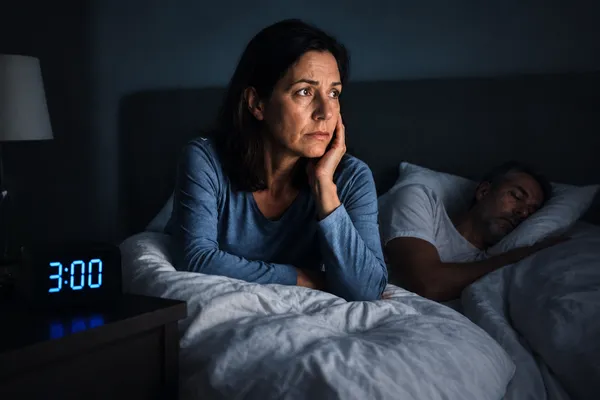
It's 3 a.m. and you're wide awake again. The house is quiet. Everyone else is asleep. But you're the one sitting up in bed, frustrated and desperate for a few more hours of rest.
You used to sleep through the night.
Now, somewhere around 2, 3 or 4 a.m., your eyes open—and that’s often it.
You’re tired. You know you need more sleep. Yet the very thing that came so naturally a few hours earlier suddenly feels impossible.
And if this started happening more often somewhere in your 40s or 50s, there’s something important to know:
Your sleep really can change in midlife.
In fact, one of the most common sleep complaints during the menopausal transition isn’t necessarily trouble falling asleep. It’s waking during the night and spending more time awake after sleep has already begun.
But menopause isn’t the entire story, and this isn’t only a women’s issue.
The way we sleep changes as we age. Our internal body clock changes. Sleep depth changes. Hormones and body temperature can interfere. And by the early-morning hours, the biological drive that helped you fall asleep at bedtime isn’t nearly as powerful as it was several hours earlier.
So why does 3 a.m. suddenly seem to have your name on it?
Here are 5 possible reasons.
1. You’re Not Sleeping as Deeply as You Used To
Here’s something you may actually be able to feel happening.
Years ago, you could sleep through your partner getting out of bed, a car passing outside or the dog moving around downstairs.
Now?
The smallest thing can pull you out of sleep.
That’s not necessarily your imagination.
Sleep changes with age. Research has found that deep, slow-wave sleep tends to decrease while nighttime awakenings and the amount of time spent awake during the night tend to increase. Many of these changes begin between young and middle adulthood—not simply when someone becomes “old.”
That means the problem may not always be that something dramatic is waking you.
It may be that you’re simply easier to wake.
The room gets a little too warm.
Your partner rolls over.
You hear a sound.
Your bladder nudges you awake.
Your shoulder or hip feels uncomfortable.
Things you once slept straight through can suddenly become enough to bring you fully into consciousness.
And that’s why you may wake up thinking:
What woke me up?
Sometimes there isn’t one obvious answer.
The bigger change may be your sleep itself.
2. Your Body Clock May Be Pulling You Toward an Earlier Morning
Here’s another change that doesn’t get talked about nearly as much.
Your internal clock can shift as you get older.
The circadian system helps determine when your body promotes sleep and when it promotes wakefulness. Research on aging has found changes in the timing and strength of these circadian signals, including a tendency toward earlier sleep and wake times.
That’s why some people notice something peculiar in midlife:
They’re sleepier earlier in the evening.
They go to bed earlier.
And then they’re awake much earlier than they want to be.
Suddenly, the person who once happily slept until 7 a.m. is staring into the darkness hours before the alarm.
This doesn’t mean your body has somehow decided that 3 a.m. is morning.
And there’s nothing medically special about 3:00 on the clock.
But your biological timing can change with age, making early waking more likely than it once was.
That distinction matters.
Because if you’ve been searching the internet for some mysterious reason your body “knows” it’s exactly 3 a.m., you may be looking for a mystery that isn’t actually there.
The more interesting question is:
Why is your sleep ending earlier than you want it to?
3. For Women, Menopause Can Change the Night
For women over 40, we can’t talk seriously about disrupted sleep without talking about menopause.
Sleep problems are among the most common and bothersome symptoms associated with the menopausal transition. And nighttime awakenings are particularly prominent.
That matters because menopause-related sleep problems don’t always look the way people expect.
You don’t necessarily lie awake for hours trying to fall asleep.
You may fall asleep perfectly well.
Staying asleep is the problem.
Research describes menopause-related sleep disturbance as involving frequent nighttime awakenings and increased time awake after falling asleep.
And it’s not simply a matter of “getting older.”
Two factors are particularly relevant during menopause: changes in the reproductive hormone environment and vasomotor symptoms such as hot flashes and night sweats.
Which means a woman can reach her 40s or 50s and genuinely think:
I haven’t changed my bedroom. I haven’t changed my mattress. I haven’t changed my bedtime. So why has my sleep changed?
Because she has changed.
Her hormonal environment is changing.
And sleep can change with it.
4. Your Internal Thermostat May Be Waking You Up
Sometimes the culprit isn’t subtle at all.
You wake up hot.
You throw off the covers.
Then you’re cold.
You pull them back on.
And now you’re completely awake.
Hot flashes and night sweats can contribute significantly to nighttime awakenings during the menopausal transition.
But here’s where the story becomes more interesting.
Researchers are still untangling exactly how hot flashes and awakenings interact. The National Institute on Aging notes that research suggests waking from sleep itself may sometimes trigger a hot flash, rather than the hot flash always being what wakes you.
That’s a fascinating distinction.
You may assume:
The hot flash woke me up.
But in some instances, the awakening may have come first.
Either way, once you’re hot, uncomfortable, throwing covers around and trying to cool down, a tiny awakening can turn into something much harder to recover from.
And you don’t necessarily have to wake up drenched in sweat for temperature to matter.
Your bedroom can be exactly the same temperature it has always been.
Your body’s response to temperature may not be.
5. Your Sleep Pressure Is Weaker at 3 A.M. Than It Was at Bedtime
This may be the piece that finally explains something incredibly frustrating:
Why can you be exhausted at bedtime, fall asleep—and then be unable to do the exact same thing several hours later?
Because biologically, those two moments aren’t the same.
From the moment you wake in the morning, your body gradually builds a need for sleep known as homeostatic sleep pressure.
The longer you’re awake, the stronger that pressure becomes.
By bedtime, you’ve accumulated an entire day’s worth.
That’s one reason you can lie down at night and feel as though sleep simply takes over.
But once you fall asleep, that pressure begins to dissipate.
Hour after hour, it becomes weaker.
So by the time you wake in the early-morning hours, you’ve already discharged a substantial amount of the sleep pressure that helped you fall asleep in the first place. Sleep research describes this pressure as increasing during wakefulness and decreasing during sleep. It also appears to become less robust with normal aging.
And suddenly your 3 a.m. problem makes a little more sense.
At 10:30 p.m., you had perhaps 15 or 16 hours of wakefulness helping drive you toward sleep.
At 3 a.m., you’ve just spent several hours reducing that drive.
Then you wake.
You become aware of the room.
You notice the clock.
You realize how early it is.
And now you’re trying desperately to recreate the sleepiness you had at bedtime—but the biological conditions aren’t the same anymore.
That’s why falling asleep initially and falling back asleep at 3 a.m. can feel like two completely different things.
And age-related changes in sleep pressure and circadian regulation may make that difference even more noticeable.
So What Can You Actually Do About It?
The first step is to stop treating every 3 a.m. awakening as though it must have the same cause.
Instead, look at your pattern.
If you’re waking hot or sweaty, temperature and menopausal symptoms deserve attention.
If you’re becoming sleepy very early in the evening and waking correspondingly early, your sleep schedule and circadian timing may be part of the picture.
If seemingly tiny sounds, movements or physical discomfort now wake you, lighter and more fragmented sleep may be contributing.
And if you’re a woman in perimenopause or menopause whose sleep suddenly looks nothing like it did five or ten years ago, that’s information worth bringing to your healthcare provider.
There are also some fundamentals worth protecting.
Keep your bedroom comfortably cool, dark and quiet.
Try to maintain reasonably consistent sleep and wake times.
Be careful with caffeine late in the day.
And don’t assume alcohol is helping simply because it makes you sleepy. The National Institute on Aging notes that even small amounts can make staying asleep more difficult.
If you wake during the night, resist turning it into a clock-watching marathon.
Seeing 3:07 become 3:24 become 3:51 rarely makes anyone more relaxed.
And your phone probably isn’t your friend at that hour either.
When It’s More Than a Bad Night
An occasional 3 a.m. awakening is one thing.
Regularly waking in the middle of the night and being unable to return to sleep is something else.
If it’s happening frequently, has persisted over time or is affecting your energy, concentration, mood or ability to function during the day, talk with a healthcare professional.
And don’t automatically assume it’s “just menopause” or “just aging.”
Sleep apnea, restless legs syndrome, pain, medications, mood disorders and other medical or sleep conditions can also disrupt sleep. Menopause itself is associated with several overlapping contributors to insomnia and sleep disturbance.
For persistent insomnia, cognitive behavioral therapy for insomnia, called CBT-I, is an evidence-based treatment. The National Institute on Aging notes that CBT-I has been shown to improve sleep in women experiencing menopausal symptoms.
The Bottom Line on Your 3 A.M. Wake-Ups
When it happens night after night, waking at the same miserable hour can start to feel as though something inside your body is deliberately flipping a switch.
But there probably isn’t one 3 a.m. switch.
There are several biological changes that can converge in the early-morning hours.
Your sleep may be lighter than it used to be.
Your internal clock may be shifting.
Perimenopause or menopause may be changing the way you sleep.
Temperature changes may be interrupting the night.
And by the time all of that is happening, the powerful sleep pressure that put you to sleep hours earlier has already faded considerably.
Suddenly, that frustrating scene makes more sense:
The house is quiet.
Everyone else is asleep.
And you’re sitting up in bed desperate for a few more hours of rest.
The clock may say 3 a.m. But the more useful question isn’t “Why 3?” It’s “What’s changed about my sleep?”
And that may be the question that finally gets you closer to an answer.
This article is for general informational purposes only and is not intended to replace professional medical advice, diagnosis or treatment. Talk with a qualified healthcare professional about persistent sleep problems or concerns about your individual health.